MemoVance Pro Official Website › Blog › MemoVance Pro Ingredients: 7-Row Checklist
MemoVance Pro Ingredients: A 7-Row Checklist
MemoVance Pro lists seven rows: niacin 7.5 mg NE, calcium 18 mg, L-arginine 200 mg, arginine AKG 200 mg, L-citrulline HCL 100 mg, citrulline malate 100 mg and beta alanine 40 mg. The five amino acids total 640 mg. There is no blend and no caffeine. Check each row against its research amount.
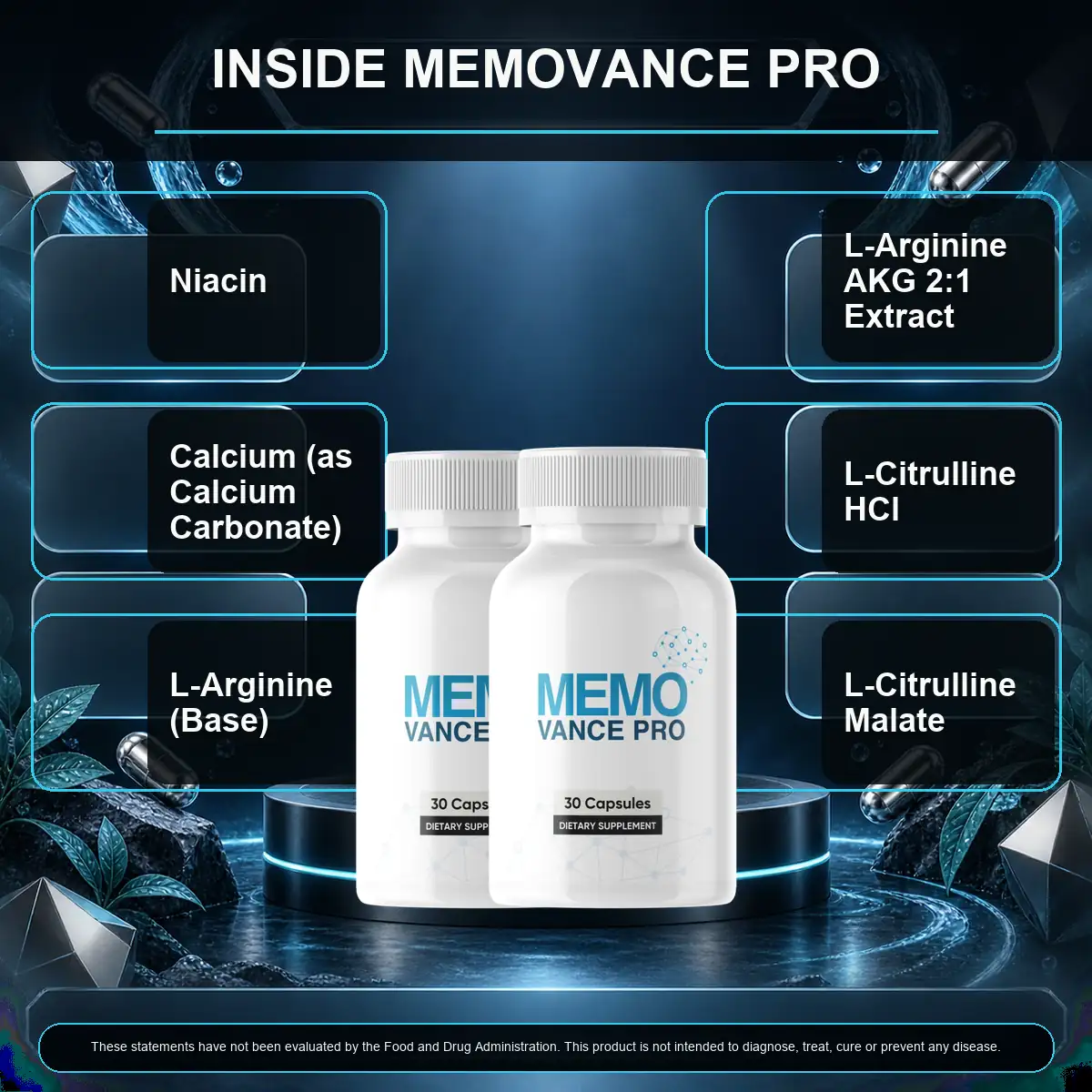
- Seven rows, each with a printed amount. Five are amino acids and total 640 mg. Two are nutrients.
- Serving: 1 capsule. 30 servings a bottle. Declared actives add up to 658 mg a capsule.
- Other ingredients: hypromellose (vegetable capsule), vegetable stearate, silicon dioxide.
- No proprietary blend and no caffeine. Nothing sweetened, coloured or flavoured is listed.
- Every amino acid row sits far below the amount its own research used.
- Calcium at 18 mg is too small to disturb a thyroid tablet or a quinolone antibiotic.
Hold the bottle against this checklist
The seller prints every row, so you can tick them off against the label that arrives.
See today's price and guarantee
30 capsules a bottle · one capsule a day · 180-day money-back guarantee, as the seller states it
Disclosure: this website earns a commission from the seller when an order placed through it completes. The price is the same either way.
What are the ingredients in MemoVance Pro?
Think of this as a checklist for the back of the bottle. There are seven rows, and each one has its own printed amount. Use the table to tick them off, then read one row at a time below.
| Row on the label | Per capsule | Research amount named on this website |
|---|---|---|
| Niacin | 7.5 mg NE (47% DV) | B3 cognition trials used 1 g a day of nicotinamide riboside, a different compound |
| Calcium (as calcium carbonate) | 18 mg (1,5% DV as printed) | Levothyroxine work used 500 mg and 1,200 mg of elemental calcium |
| L-Arginine (base) | 200 mg | Blood pressure effect from 4 g a day; none beyond 9 g |
| L-Arginine AKG 2:1 extract | 200 mg | Both AAKG studies ran at 12 g a day |
| L-Citrulline HCL | 100 mg | Dose-ranging study used 2, 5, 10 and 15 g |
| L-Citrulline malate | 100 mg | Trials used 8 g and 12 g |
| Beta alanine | 40 mg | Loading is 4 to 6 g a day; cognition results came from 2.4 g |
Amounts per capsule are the label figures. Research amounts are those the seller's pages quote from named studies.
Add the five amino acid rows and you get 640 mg. With niacin and calcium, the declared total is 658 mg.
Row 1: What is niacin doing in a memory capsule?
Niacin is vitamin B3. The label prints it in niacin equivalents, which is why the unit reads mg NE. At 7.5 mg NE it is roughly a meal-sized amount, and it is the only row with a figure in the range of normal nutrition. The 47% Daily Value fits a reference of about 16 mg NE, so this percentage reconciles.
The link to thinking runs through the NAD system that every cell uses for energy. The firm, long-known link is to deficiency disease. Do not confuse this row with the research on B3 and the brain. That research used 1 g a day of nicotinamide riboside, in the Wake Forest trial and a crossover trial at Massachusetts General. It is a different compound at a far larger scale.
One practical point: at this size there is no niacin flush. Do not wait for a warm face as a sign the capsule is working.
Row 2: Why is the calcium only 18 mg?
Calcium carbonate is a cheap, dense calcium salt. Here it supplies 18 mg of elemental calcium, which is tiny. In a capsule that size it is as much about bulk and flow as about nutrition.
The small figure is useful. Calcium carbonate can bind levothyroxine in the gut, and the studies on that used 500 mg and 1,200 mg of elemental calcium, as in the JAMA study. Quinolone antibiotics are bound by the same mechanism. At 18 mg this capsule cannot reach those amounts. A person who takes a real calcium tablet still has to space that tablet from their medicine.
Rows 3 and 4: Why two kinds of L-arginine?
Arginine is the raw material the body uses to make nitric oxide, a signal that relaxes the muscle around a blood vessel. The label carries it twice: 200 mg of free-form base and 200 mg of arginine AKG, which is arginine bonded two to one with alpha-ketoglutarate.
Ordinary eating already supplies roughly 4 to 5 g of arginine a day. The 2022 dose-response meta-analysis found a blood pressure effect from 4 g a day upward, none beyond 9 g, and none in trials running past 24 days. The AKG salt was tested at 12 g a day, in an eight-week pharmacokinetic trial and a one-week blood-flow trial.
So the 200 mg rows are small next to those amounts. Carrying both forms is a hedge across the question of how much survives the gut.
Rows 5 and 6: Why two kinds of L-citrulline?
Swallowed arginine meets an enzyme in the gut wall and liver that breaks much of it down. Citrulline is not a target of that enzyme, so it passes through and is rebuilt into arginine in the kidney. That is why a panel adds citrulline to arginine.
The label has citrulline HCL at 100 mg and citrulline malate at 100 mg. The hydrochloride is a solubility choice. The malate form pairs citrulline with malic acid, so part of that 100 mg is malic acid by weight, and the citrulline itself is less than 100 mg. The ratio is not printed.
For scale, the Citrudose study climbed 2, 5, 10 and 15 g in the same volunteers. Its smallest step is twenty of these 100 mg rows.
Row 7: What does 40 mg of beta alanine add?
Beta alanine is the odd one out. It is not part of the nitric oxide pathway. It is the limiting half of carnosine, a compound stored in muscle and brain tissue over weeks of daily intake. It is also the row whose research points most closely at thinking.
The ISSN position stand describes loading as 4 to 6 g daily for at least four weeks. A ten-week trial in older adults used 2.4 g a day. A fourteen-week study at 6.4 g a day moved neither of the two outcomes it measured. So the evidence is mixed, and 40 mg is far below all of it.
At 40 mg you will also not feel the tingling this ingredient is known for. That needs single doses in the hundreds of milligrams.
What else is in the capsule, and is it vegetarian?
The other-ingredients line reads hypromellose (vegetable capsule), vegetable stearate and silicon dioxide. Hypromellose is a plant cellulose, so the shell is not gelatin and the capsule suits a vegetarian diet (a review of the polymer). Vegetable stearate helps powder flow through the filling machine. Silicon dioxide stops powder clumping (the EFSA re-evaluation).
No allergen statement is printed on the artwork. None of the ten listed ingredients is a common allergen, though anyone with a known allergy should read the bottle and ask a pharmacist.
Does it use a proprietary blend? No. Does it contain caffeine? No. Neither appears on the label.
MemoVance Pro is a dietary supplement. It is not FDA approved, and no dietary supplement is. These statements have not been evaluated by the Food and Drug Administration. The product is not intended to diagnose, treat, cure or prevent any disease. Questions about your health belong with a doctor or pharmacist who knows your history.
Frequently asked questions
How many active ingredients does MemoVance Pro contain?
Seven rows: two nutrients, niacin and calcium, and five amino acids that total 640 mg a capsule.
Does MemoVance Pro use a proprietary blend?
No. Each of the seven rows prints its own amount, so no blend total hides the split.
Is there caffeine in MemoVance Pro?
No. Caffeine is not among the seven rows or the three inactive ingredients, and nothing on the panel is a stimulant.
Is the MemoVance Pro capsule suitable for vegetarians?
The shell is hypromellose, a plant cellulose, and no animal-derived material appears on the other-ingredients line.
Why does the label show 1,5% for calcium?
The artwork prints it with a decimal comma. The figure does not match a usual Daily Value, since 18 mg is 1.38% of 1,300 mg and 1.8% of 1,000 mg.
Are the amounts the same as in the research?
No. Each amino acid row is far below the amount its own research used, and all five miss in the same direction. No trial has tested the finished capsule.
Our view
The best thing about this label is that it prints everything. Seven rows, seven amounts, a short inactive list and no blend. You can check every line yourself.
The weak point is size. The five amino acid rows are small next to the amounts their research used, so be modest about what to expect. The two nutrient rows are sensible for what they are.
Use the checklist to judge it as a daily habit with open numbers, not as a copy of a trial. Ask your pharmacist about any medicine you take, especially for blood pressure.
Sources named on this website
- NIH Office of Dietary Supplements consumer fact sheet
- FDA questions and answers on dietary supplements
Order with all seven rows in front of you
Once you have read the amounts and the research gap, the checkout shows the current price and the written refund term.
Check the current price and guarantee
30 capsules a bottle · one capsule a day · 180-day money-back guarantee, as the seller states it
Disclosure: this website earns a commission from the seller when an order placed through it completes. The price is the same either way.
Keep reading: How it works, four steps · Does it work? Six questions · The ingredients page