MemoVance Pro Official Website › Blog › Does MemoVance Pro Really Work?
Does MemoVance Pro Really Work? 6 Questions to Ask
No published trial has tested the finished MemoVance Pro capsule. Its amino acid rows are far below the amounts used in their research, and that research is mostly about blood pressure and exercise. The seller claims only cognitive function and mental clarity. A slow, self-measured test is the honest way to find out.
- Sold for two things: cognitive function and mental clarity. Both phrases come from the seller's page.
- No trial has been run on this finished capsule, and none is published.
- Five of seven rows come from blood pressure and exercise research.
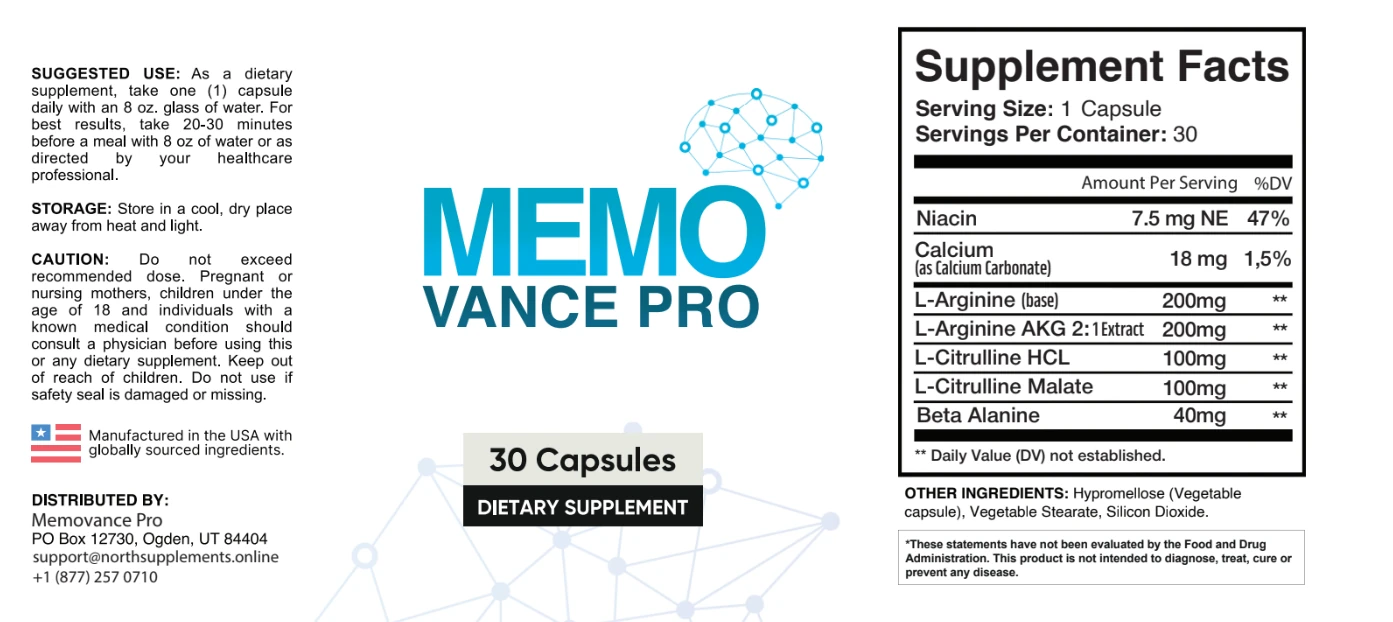
- Beta alanine has the closest cognition research. Its trials used 2.4 g a day. The label row is 40 mg.
- It does not treat memory loss, Alzheimer's disease or any other disease.
- A fair test takes weeks. The distributor gives 4-8 weeks as the usual wait.
Judge the evidence first, the capsule second
If you decide a slow, modest test is worth running, the checkout shows the price and the written 180-day term.
See today's price and guarantee
30 capsules a bottle · one capsule a day · 180-day money-back guarantee, as the seller states it
Disclosure: this website earns a commission from the seller when an order placed through it completes. The price is the same either way.
Question 1: What would "work" even mean here?
Start by fixing the target. The seller's page says the capsule is for cognitive function and mental clarity. Those are general wellness phrases, not medical results. The bottle makes no claim at all beyond the FDA statement, and the seller does not say MemoVance Pro treats anything.
So "does it work" cannot mean "does it cure memory loss". It can only mean something smaller: after weeks of daily use, do you notice a countable difference in things like lost words or forgotten errands? That is a modest question, and it is the only fair one.
Also fix one fact in your mind. No trial has been run on this finished capsule. Every study quoted by the seller's pages tested single ingredients, usually at larger amounts.
Question 2: What does the research behind each row measure?
Two groups of research sit under this label, and they measure different things.
- Arginine and citrulline rows (four rows). Their research is about blood pressure, blood flow and exercise output. A real pathway, but not a memory test. For example, the 2022 dose-response meta-analysis looked at blood pressure.
- Beta alanine. It has the closest cognition research, in older adults at 2.4 g a day for ten weeks, with a pooled analysis of delayed recall that gathered trials giving carnosine itself (the meta-analysis). A fourteen-week study at 6.4 g moved neither BDNF nor a Stroop test (the null result).
- Niacin. The B3 cognition trials used 1 g a day of nicotinamide riboside. The larger of the two found no difference from placebo on its primary outcome (Wake Forest and Massachusetts General).
Calcium at 18 mg is a trace nutrient and carries no cognition research here.
Question 3: How do the label amounts compare with the research amounts?
| Row | On the label | In the research |
|---|---|---|
| L-Arginine (base) | 200 mg | Effect from 4 g a day; none beyond 9 g |
| L-Arginine AKG | 200 mg | 12 g a day in both studies |
| L-Citrulline HCL | 100 mg | Smallest study step was 2 g |
| L-Citrulline malate | 100 mg | 8 g and 12 g in trials |
| Beta alanine | 40 mg | 2.4 g in cognition trials; 4 to 6 g loading |
| Niacin | 7.5 mg NE | 1 g a day of a different compound |
Figures as quoted on the seller's pages from the named studies.
All five amino acid rows miss in the same direction. That is one finding, not five. It means the research cannot simply be borrowed to say what the capsule does. It does not mean the capsule is unsafe. Small amounts also carry small risk.
Question 4: Does it help with memory loss or Alzheimer's disease?
No claim of that kind is made, and none should be inferred. MemoVance Pro is not a drug. It does not treat memory loss, and it does not slow decline. It is not intended to diagnose, treat, cure or prevent any disease, Alzheimer's disease included.
Everyone loses a name now and then, and much of it is attention, not memory. Short sleep and a busy day are common causes. But a change that other people have noticed, a familiar route that stops feeling familiar, or the same question asked twice in a conversation should be assessed by a clinician. A supplement started in its place costs time that matters.
Question 5: Is there any honest case for trying it?
There is a modest one.
- It is one capsule a day, so it is easy to keep up.
- Every amount is printed, so nothing is hidden in a blend.
- The calcium row is too small to interfere with a thyroid tablet.
- The refund term is 180 days from purchase, opened bottles included.
- The seller's page suggests following the directions for at least 180-210 days. That is the seller's instruction, not our advice.
The case against is just as plain. The amounts are small, the research is borrowed, and a slow product is hard to judge.
Question 6: How can you test it fairly yourself?
Run a small, honest experiment. It costs a notebook.
- Pick one countable thing before the first capsule, such as how often a word goes missing mid-sentence in a week.
- Count it for a week before you start.
- Write the start date on the bottle.
- Take one capsule a day as the label directs, and keep a tick for each day.
- Count the same thing again in the final week, and note your sleep, because short sleep moves the same outcomes.
One person with no placebo cannot prove anything. But it answers the only question you need: is this worth buying again? The distributor gives 4-8 weeks as the usual wait, so do not judge in week one.
No supplement is FDA approved, and this one is no exception. It does not treat memory loss or any other disease. If a change in memory has been noticed by you or by people around you, ask a doctor to assess it. Do not start a supplement instead.
Frequently asked questions
Does MemoVance Pro really work?
Not proven. No trial has tested the finished capsule, and its amino acid rows are far below the amounts used in their research. It is sold only for cognitive function and mental clarity, and any effect would be slow and modest.
Is there a clinical trial of MemoVance Pro?
None is published. The studies named on the seller's pages tested single ingredients, usually at much larger amounts than the label shows.
Does MemoVance Pro treat memory loss or Alzheimer's disease?
No. It is a dietary supplement. It is not a drug, it does not treat memory loss, and it is not intended to diagnose, treat, cure or prevent any disease.
Why does the research use much bigger amounts?
Researchers use amounts large enough to measure an effect. The label shows 200 mg of arginine where blood pressure effects start at 4 g a day, and 40 mg of beta alanine where cognition trials used 2.4 g.
Will I feel anything on day one?
No. There is no stimulant on the panel, and nothing in it acts in a way you can feel on the day. The distributor gives 4-8 weeks as the usual wait.
When should I see a doctor instead?
If other people have noticed a change in your memory, or if you lose familiar routes or repeat questions. Get that assessed before you try any supplement.
Our view
MemoVance Pro is not proven to work, and it does not claim to cure anything. The honest status is this: a modest, slow, open-label supplement with research that points in a few directions and does not reach the label amounts.
If you want to try it, treat it as a personal experiment. Pick your measure first, keep notes, give it weeks, and use the refund term if the answer is no.
If you are worried about your memory, make that appointment first. That advice outranks everything else on this page.
Sources named on this website
Run the test with a refund term behind you
The seller states 180 days from the date of purchase, which is long enough to run a careful test.
See today's price and guarantee
30 capsules a bottle · one capsule a day · 180-day money-back guarantee, as the seller states it
Disclosure: this website earns a commission from the seller when an order placed through it completes. The price is the same either way.
Keep reading: How it works · How long it takes · Results timeline