MemoVance Pro Official Website › Ingredients
IngredientsWhat Is in MemoVance Pro? Every Ingredient Listed
MemoVance Pro lists seven ingredients, and every one has a milligram amount.
One capsule holds niacin 7.5 mg NE, calcium 18 mg, L-arginine 200 mg, L-arginine AKG 200 mg, L-citrulline HCl 100 mg, L-citrulline malate 100 mg and beta alanine 40 mg.
Read about each step on the how it works page.
Every row read off the bottle, what form it arrives in, and the quantity its own published research worked with.
How the weight inside a MemoVance Pro capsule divides up
Four fifths of everything declared on this bottle is arginine in one form or another.
| Row | Per capsule | Share of the actives | What kind of row it is |
|---|---|---|---|
| L-Arginine (base) | 200 mg | 30% | Free-form amino acid |
| L-Arginine AKG 2:1 Extract | 200 mg | 30% | Amino acid as a keto-acid salt |
| L-Citrulline HCL | 100 mg | 15% | Amino acid as a hydrochloride |
| L-Citrulline Malate | 100 mg | 15% | Amino acid with a fruit acid |
| Beta Alanine | 40 mg | 6% | Free-form amino acid |
| Calcium (as Calcium Carbonate) | 18 mg | 3% | Mineral, 1,5% Daily Value |
| Niacin | 7.5 mg NE | 1% | B vitamin, 47% Daily Value |
Shares are of the 658 mg of declared actives, rounded to whole per cent. Weights are as the artwork prints them.
Every MemoVance Pro ingredient, one row at a time
Seven cards, seven printed amounts, and the quantity the published work used for each.
L-Arginine
base, free-form200 mg · trials worked at 4–9 g a dayThe largest single figure on the bottle and the row the rest of the formula is built around. Arginine is the substrate an enzyme in the vessel wall turns into nitric oxide, which is the signal that tells a small artery to relax.
It is also a normal part of dinner. Meat, fish, nuts, seeds and pulses supply somewhere around four to five grams of it across an ordinary day, so a 200 mg row arrives on top of a supply that is already in place. The 2022 dose-response pooling put the threshold for a measurable blood pressure change at four grams a day and found nothing above nine, which sets the scale this row is competing on. A formal risk assessment works in the same units.
L-Arginine AKG 2:1 Extract
arginine alpha-ketoglutarate200 mg · both trials used 12 g a dayThe same amino acid bonded to alpha-ketoglutarate, a compound from the middle of the citric acid cycle, in a two-to-one ratio. The salt was popular in gym supplements for a decade on the theory that the keto-acid half survives the gut better than arginine alone.
Two human trials carry that theory. The pharmacokinetic study gave four grams three times a day and the blood-flow study gave twelve grams a day for a week, measuring flow directly. The word “extract” on this row is the unusual part: AAKG is a manufactured salt rather than something drawn out of a plant.
L-Citrulline HCL
hydrochloride salt100 mg · smallest study arm was 2 gCitrulline is the reason this panel is more interesting than a plain arginine capsule. Swallowed arginine meets an enzyme called arginase in the gut wall and the liver, and a large share of it never reaches the bloodstream as arginine. Citrulline is not a substrate for that enzyme, so it survives the trip intact and is rebuilt into arginine downstream in the kidney. That detour is what makes it the more efficient way to raise circulating arginine.
The hydrochloride is a solubility choice, not an activity one. The dose-ranging pharmacokinetic study climbed 2, 5, 10 and 15 grams in the same volunteers; its smallest arm is twenty of these rows.
L-Citrulline Malate
citrulline with malic acid100 mg · performance trials used 8–12 gTwo ingredients sold as one. Malic acid is a fruit acid that also sits in the citric acid cycle, and the pairing is the form nearly every exercise trial has used. The ratio decides how much of the printed weight is actually citrulline: at two parts to one it is roughly 72 mg of this row, and at one part to one closer to 57 mg.
Whether the malate earns its place is a live question rather than a settled one. A 2025 crossover ran citrulline against an equivalent citrulline malate dose head to head, and a 2022 meta-analysis pooled the strength trials that made the ingredient popular.
Beta Alanine
free-form40 mg · loading protocols run 4–6 g a dayThe odd one out. Beta alanine is not part of the nitric oxide pathway at all; it is the rate-limiting half of carnosine, a dipeptide that accumulates inside muscle and brain tissue over weeks of daily intake.
Carnosine is also the one ingredient family on this panel with a cognition result attached to it, which is presumably why it is here. The sports nutrition position stand describes loading as four to six grams daily for at least a month, with the tingling sensation the ingredient is known for arriving at single doses measured in hundreds of milligrams.
Calcium
as calcium carbonate18 mg · 1,5% Daily Value as printedCarbonate is the densest and cheapest calcium salt, about forty per cent elemental calcium by weight, so 18 mg of calcium arrives inside roughly 45 mg of the raw material. In a capsule this size that is bulk and flow as much as it is nutrition.
The useful thing about a row this small is what it rules out. The absorption work on levothyroxine used formulations containing 500 mg of elemental calcium, and the caution every pharmacist gives about calcium and thyroid tablets is built on that scale. Eighteen milligrams is nowhere near it.
Niacin
vitamin B3, as niacin equivalents7.5 mg NE · 47% Daily Value as printedPrinted in niacin equivalents, the unit that counts both niacin itself and the amount the body can make from dietary tryptophan. At 7.5 mg NE this is a meal-sized quantity of a vitamin most adults already get from bread, meat and coffee.
It is also the only row on the bottle whose percentage can be checked against itself: 47 per cent of a Daily Value implies a reference around 16 mg NE, and the two figures agree. The flushing reaction people associate with niacin belongs to doses two orders of magnitude above this one, so nobody should wait for a warm face as a sign the capsule is working.
What the salt on each MemoVance Pro row changes
The counter-ion is the quiet half of a milligram figure.
Four of the seven rows name a chemical form as well as an amount, and the form is the part of a panel that usually goes unread. It decides how much of the printed weight is the active molecule and how the molecule behaves once it is swallowed.
| Row as printed | The form | What it changes |
|---|---|---|
| L-Arginine (base) | Free base | All 200 mg is arginine. Nothing else is carried along, which makes this the cleanest figure on the panel to reason about. |
| L-Arginine AKG 2:1 Extract | Alpha-ketoglutarate salt | Part of the 200 mg is the keto-acid. The two-to-one ratio is stated, which is more than most AAKG labels manage. |
| L-Citrulline HCL | Hydrochloride | A small share of the weight is chloride. The salt dissolves readily, which matters more in a drink powder than in a capsule. |
| L-Citrulline Malate | Malic acid pairing | Between a quarter and just under a half of the row is malate, depending on the ratio used. It is the one figure on this bottle that cannot be read straight. |
| Beta Alanine | Free-form | All 40 mg is beta alanine, which is also why the tingling threshold is a clean comparison to make. |
| Calcium (as Calcium Carbonate) | Carbonate | The 18 mg is elemental calcium, as US panels require. The carbonate it arrives in weighs about two and a half times that. |
| Niacin | Niacin equivalents | NE counts tryptophan conversion as well as niacin itself, which is why the unit is written the way it is. |
Read off the artwork. Where the artwork names no ratio, as on the citrulline malate row, the range is given rather than a single figure.
The MemoVance Pro ingredient graphic and the bottle, side by side
What the seller's own artwork names, and what the bottle adds to it.
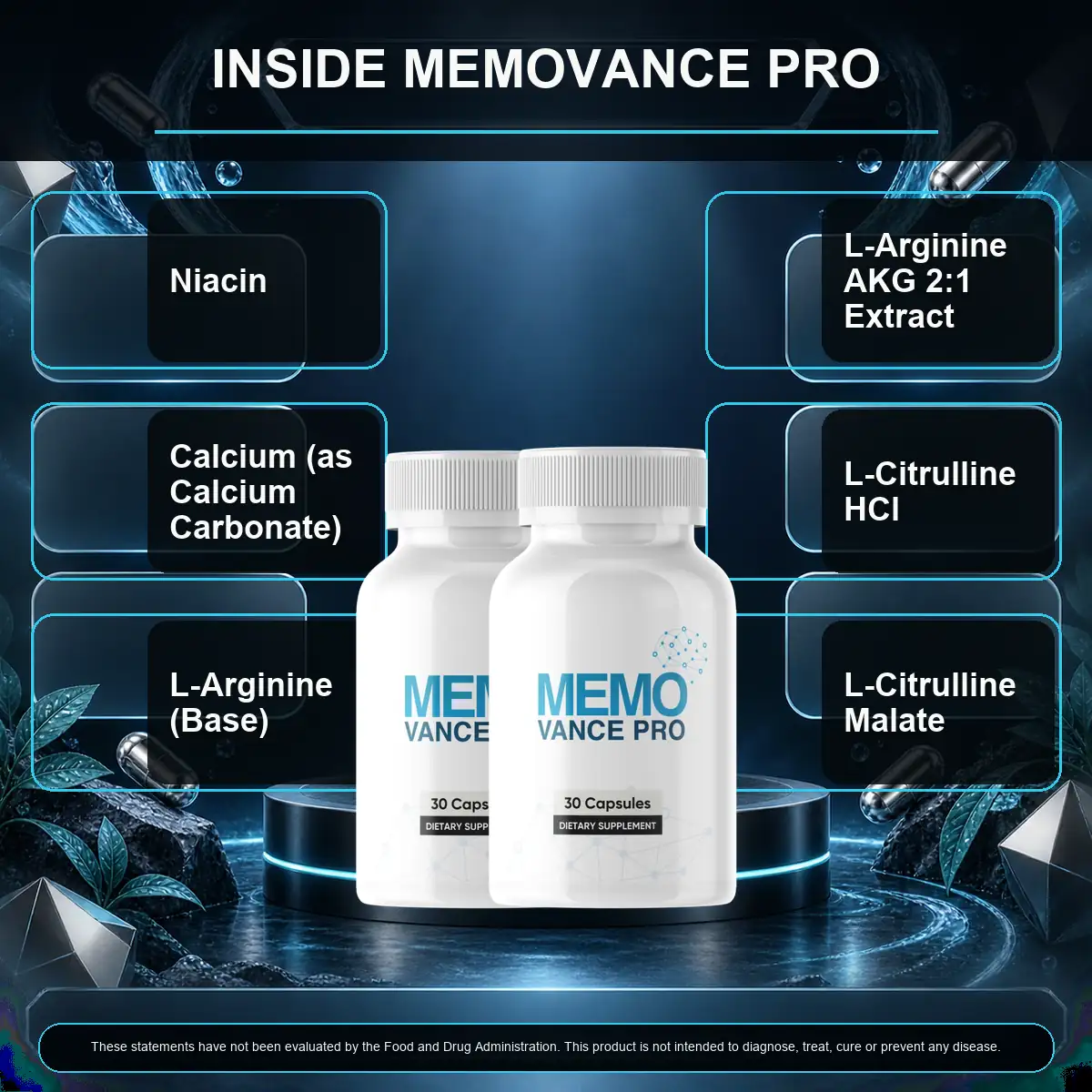
The seller ships an “INSIDE MEMOVANCE PRO” panel of its own, and it gives a labelled box to 6 ingredients: niacin, calcium, both arginines and both citrullines. Beta alanine has no box.
So the graphic and the bottle agree on six rows out of seven and the seventh is a 40 mg row at the bottom of the panel. That is corroboration rather than conflict, and it is worth saying because the two documents were produced by different people for different purposes.
Where a graphic and a printed panel differ, the panel is the one that arrived in the parcel and the panel is what this website transcribes. The supplement facts page prints all 7 rows in text, including the footnote.
What else is inside a MemoVance Pro capsule
Shell, lubricant and anti-caking agent, and what each is doing there.
Three inactive ingredients are declared under the panel, and each has a manufacturing job rather than a nutritional one.
Hypromellose is the capsule itself: a cellulose polymer drawn from plant fibre, used because it forms a shell that is stable, tasteless and free of animal material. A patent review of the polymer covers how widely it is used in oral dosage forms. It is the reason this capsule suits a vegetarian diet, and the reason it can be pulled apart if somebody would rather take the contents in water.
Vegetable stearate is a lubricant. Powder blends have to slide through filling machinery at speed without sticking, and a stearate is what makes a consistent fill weight possible.
Silicon dioxide is the anti-caking agent, present in fractions of a milligram. The European re-evaluation of it as a food additive ran the full toxicological review in 2018. It stops amino acid powder from clumping in a humid warehouse.
Hypromellose (Vegetable capsule); Vegetable Stearate; Silicon Dioxide. No colouring, no sweetener, no flavour and no binder beyond the stearate. For a capsule carrying 640 mg of amino acid powder that is a short list.
Honest ingredient analysis: what the MemoVance Pro amounts add up to
One finding rather than seven, and the reason it is worth stating plainly.
Read the seven rows as a group rather than one at a time and a single finding falls out of them, which is easier to judge than seven separate ones.
The two nutrient rows are the right size for what they are. A B vitamin at a meal's worth and a mineral at trace level are ordinary inclusions in a capsule and neither creates a problem. The calcium figure is small enough to stay out of the way of medicines that real calcium supplements interfere with, which is a point in the formula's favour rather than against it.
The five amino acid rows all sit below the quantities their own trials used, and they miss in the same direction and by a broadly similar factor. That makes it one finding about one design decision rather than five separate shortfalls. Whoever specified this capsule chose breadth across a pathway over depth on any single row of it, and 640 mg is what fits in a capsule somebody will swallow once a day.
Every figure and the research quantity beside it is set out in the honest dosage section of the home page. The point of printing them at all is that this comparison can be made: a proprietary blend would have made the same capsule impossible to assess.
What the panel gets right
- All 7 rows carry a number, so nothing has to be taken on trust.
- The plant-free capsule shell and a three-item inactives line keep the bottle simple.
- The calcium row is too small to reach the interactions calcium is known for.
- Niacin's percentage and its milligram figure agree with each other.
- Two citrulline forms and two arginine forms cover the pathway from both ends.
What the amounts cost it
- Every amino acid row is a fraction of the quantity its own trials used.
- The citrulline malate ratio is left open, so part of that 100 mg is malic acid.
- Beta alanine at 40 mg is a long way below any loading protocol in the literature.
- Four fifths of the declared weight is arginine in two forms, which narrows the formula considerably.
- A cognitive supplement built on a vascular amino acid stack is an indirect route to the outcome it is sold for.
MemoVance Pro ingredient questions, answered
How many active ingredients does MemoVance Pro contain?
Seven, and the bottle prints an amount beside each. Two are nutrients, niacin and calcium, and five are amino acids totalling 640 mg per capsule.
Does MemoVance Pro use a proprietary blend?
No. A proprietary blend prints one total for a group of ingredients and hides the split between them. This panel gives each row its own figure, which is what makes the comparison on this website possible at all.
Is there caffeine in MemoVance Pro?
No. Caffeine would have to be declared on the panel and it is not among the seven rows, nor among the three inactive ingredients. Nothing in the formula is a stimulant in the ordinary sense.
Why does MemoVance Pro carry two kinds of arginine?
Free-base arginine and arginine alpha-ketoglutarate behave differently once swallowed, and the AKG salt was formulated on the theory that more of it survives the gut. Carrying both is a hedge across that question.
Is the MemoVance Pro capsule suitable for vegetarians?
The shell is hypromellose, a plant cellulose, and no animal-derived material appears on the other-ingredients line. Anyone avoiding gelatin capsules can read that line on the bottle itself.
Are there allergens in MemoVance Pro?
The artwork carries no allergen statement, and none of the seven actives or three inactives is a common allergen. Amino acids are manufactured by fermentation rather than extracted from food proteins.
Who publishes this MemoVance Pro website?
- Javaid A, Mudavath SL. Niacin-induced flushing: Mechanism, pathophysiology, and future perspectives. Arch Biochem Biophys. 2024;761:110163. PMID 39322100. https://pubmed.ncbi.nlm.nih.gov/39322100/
- Zamfirescu I, Carlson HE. Absorption of levothyroxine when coadministered with various calcium formulations. Thyroid. 2011;21(5):483-6. PMID 21595516. https://pubmed.ncbi.nlm.nih.gov/21595516/
- Shiraseb F, Asbaghi O, Bagheri R, et al. Effect of l-Arginine Supplementation on Blood Pressure in Adults: A Systematic Review and Dose-Response Meta-analysis of Randomized Clinical Trials. Adv Nutr. 2022;13(4):1226-1242. PMID 34967840. https://pubmed.ncbi.nlm.nih.gov/34967840/
- Shao A, Hathcock JN. Risk assessment for the amino acids taurine, L-glutamine and L-arginine. Regul Toxicol Pharmacol. 2008;50(3):376-99. PMID 18325648. https://pubmed.ncbi.nlm.nih.gov/18325648/
- Wu Z, Hou Y, Hu S, et al. Catabolism and safety of supplemental L-arginine in animals. Amino Acids. 2016;48(7):1541-52. PMID 27156062. https://pubmed.ncbi.nlm.nih.gov/27156062/
- Campbell B, Roberts M, Kerksick C, et al. Pharmacokinetics, safety, and effects on exercise performance of L-arginine alpha-ketoglutarate in trained adult men. Nutrition. 2006;22(9):872-81. PMID 16928472. https://pubmed.ncbi.nlm.nih.gov/16928472/
- Willoughby DS, Boucher T, Reid J, et al. Effects of 7 days of arginine-alpha-ketoglutarate supplementation on blood flow, plasma L-arginine, nitric oxide metabolites, and asymmetric dimethyl arginine after resistance exercise. Int J Sport Nutr Exerc Metab. 2011;21(4):291-9. PMID 21813912. https://pubmed.ncbi.nlm.nih.gov/21813912/
- Moinard C, Nicolis I, Neveux N, et al. Dose-ranging effects of citrulline administration on plasma amino acids and hormonal patterns in healthy subjects: the Citrudose pharmacokinetic study. Br J Nutr. 2008;99(4):855-62. PMID 17953788. https://pubmed.ncbi.nlm.nih.gov/17953788/
- Aguiar AF, Casonatto J, Silva AM, et al. Effects of Citrulline Malate Supplementation on Muscle Strength in Resistance-Trained Adults: A Systematic Review and Meta-Analysis of Randomized Controlled Trials. J Diet Suppl. 2022;19(6):772-790. PMID 34176406. https://pubmed.ncbi.nlm.nih.gov/34176406/
- Martin-Olmedo JJ, Miras-Moreno S, Jaen-Carrillo D, et al. Malate or Not? Acute Effects of L-Citrulline Versus Citrulline Malate on Neuromuscular Performance in Young, Trained Adults: A Randomized, Double-Blind, Placebo-Controlled Crossover Trial. Int J Sport Nutr Exerc Metab. 2025;35(2):89-98. PMID 39662304. https://pubmed.ncbi.nlm.nih.gov/39662304/
- Trexler ET, Smith-Ryan AE, Stout JR, et al. International society of sports nutrition position stand: Beta-Alanine. J Int Soc Sports Nutr. 2015;12:30. PMID 26175657. https://pubmed.ncbi.nlm.nih.gov/26175657/
- Guarve K, Kriplani P. HPMC- A Marvel Polymer for Pharmaceutical Industry-Patent Review. Recent Adv Drug Deliv Formul. 2021;15(1):46-58. PMID 34086557. https://pubmed.ncbi.nlm.nih.gov/34086557/
- EFSA Panel on Food Additives and Nutrient Sources added to Food (ANS). Re-evaluation of silicon dioxide (E 551) as a food additive. EFSA J. 2018;16(1):e05088. PMID 32625658. https://pubmed.ncbi.nlm.nih.gov/32625658/
Order MemoVance Pro with all seven amounts in front of you
One capsule a day, 30 to a bottle, every row printed with its own figure and 180 days from the date of purchase to change your mind.
$79, $69 or $49 a bottle by pack size · 180-day money-back guarantee
Order MemoVance Pro On The Official WebsiteLot MEM-26/TH-4477 · 30 capsules · 7 rows, 7 printed figures