MemoVance Pro Official Website › Blog › Is There a MemoVance Pro Clinical Trial? 6 Checks on the Evidence
Is There a MemoVance Pro Clinical Trial? 6 Checks on the Evidence
Evidence questions deserve a straight list. We go through six, in the order a careful reader would ask them, and we keep the answer to what the site's own sources say.
No clinical trial has been run on the finished MemoVance Pro capsule. Research exists on its ingredients one at a time, mostly at far larger amounts than the label prints, and mostly on blood pressure, exercise or carnosine, not on memory in the product's buyers. Results are not promised.
- Trials on the finished MemoVance Pro capsule: none published.
- Ingredient research exists, at amounts well above the printed ones.
- Most of it concerns blood pressure, exercise output or muscle carnosine.
- The closest cognition work is on beta alanine at 2.4 g a day. The label prints 40 mg.
- No before-and-after photos or measured results from buyers are published.
- Not FDA approved. Not intended to diagnose, treat, cure or prevent any disease.
Check 1: Has the finished capsule been tested in a trial?
No. The site states it plainly: no trial has been run on this finished capsule. The combination of seven rows at these amounts has never been studied as a combination. Anyone who quotes a clinical trial for MemoVance Pro is referring to something this website cannot find.
That does not make the capsule unsafe or useless. It means the evidence is indirect. The rest of this page is about how to read indirect evidence without being fooled by it.
Check 2: Do the ingredient studies use the same amounts?
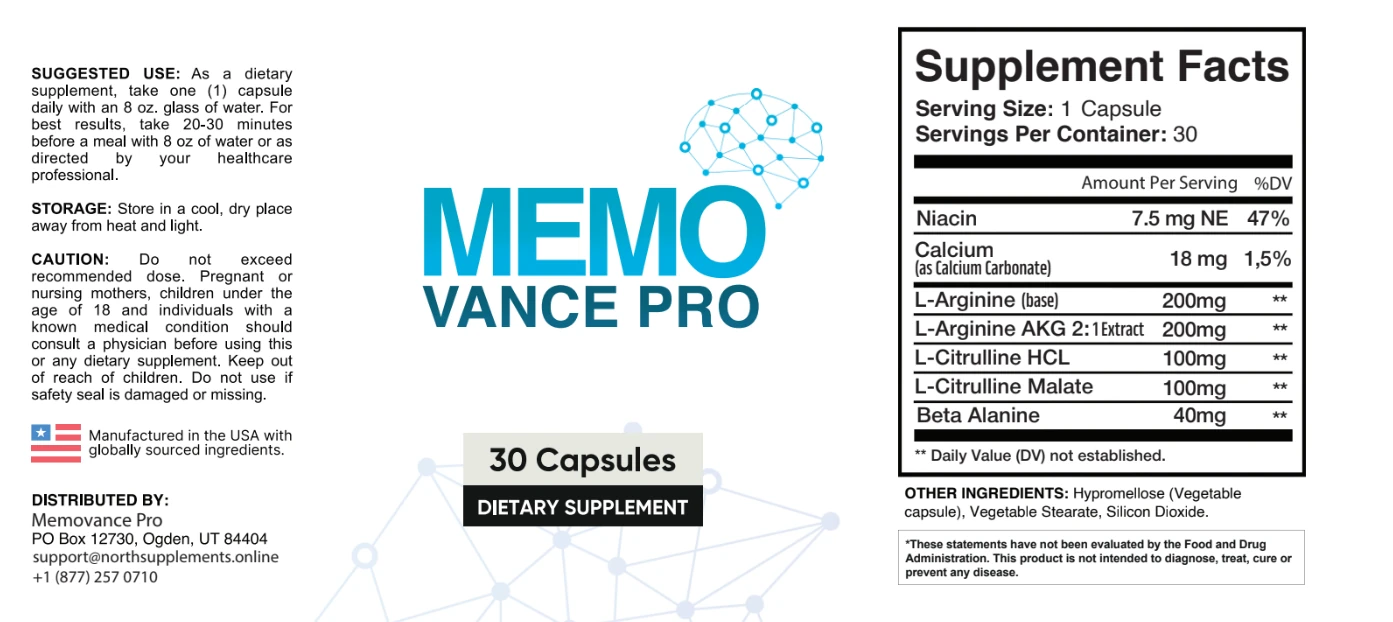
No, and this is the key gap. Each amino acid row sits far below the amount its research used. The table sets them side by side, using figures the site's own pages cite.
| Row on the bottle | Printed | What the cited research used | What it measured |
|---|---|---|---|
| L-Arginine (base) | 200 mg | Effects began at 4 g a day and none was found above 9 g | Blood pressure, pooled across trials |
| L-Arginine AKG 2:1 | 200 mg | 4 g three times a day; 12 g a day for a week | Blood flow and exercise in trained men |
| L-Citrulline HCL | 100 mg | 2, 5, 10 and 15 g in a dose-ranging study | Plasma amino acids and hormones |
| L-Citrulline Malate | 100 mg | 8 g in one trial, 12 g in another | Exercise work and repetitions |
| Beta Alanine | 40 mg | 4 to 6 g loading; 2.4 g in cognition work; 6.4 g for fourteen weeks | Muscle carnosine, recall, BDNF and a Stroop test |
| Niacin | 7.5 mg NE | 1 g a day of a different compound (nicotinamide riboside) | Cognition in older adults |
| Calcium | 18 mg | 500 mg and 1,200 mg of elemental calcium | Absorption of other medicines |
Figures are the ones the site's own pages quote from its listed sources. None of them is a finding about the finished capsule.
Want to see today's price?
MemoVance Pro is a once-a-day capsule, and the seller's checkout shows the current price and the 180-day money-back term before you pay.
See today’s price and guaranteeThememovancepro earns a commission, paid by the seller, when an order placed through this website goes through. The price you pay is not affected.
Check 3: Did those studies measure memory?
Mostly not. The arginine and citrulline studies looked at blood pressure, blood flow and exercise. The beta alanine work is the closest to recall, which is why it matters. A controlled study in 60 to 80-year-olds ran ten weeks at 2.4 g a day. A diffusion-MRI follow-up looked at brain structure. An executive-function trial followed endurance work in middle-aged people.
Even the nearest memory finding, a pooled analysis of delayed recall, pooled trials that gave people carnosine itself, not beta alanine. That is a useful hint, not a match.
Check 4: Do the results agree with each other?
No, and the site says so instead of tidying it up. In a fourteen-week study at 6.4 g a day, neither BDNF nor a Stroop test moved. The niacin studies used 1 g a day of nicotinamide riboside, a different compound at a hundred times the scale, and the bigger of the pair showed no gap from placebo on its main outcome.
When results split, a careful reader holds the question open. That is the right stance here too.
Check 5: Who were the people in those studies?
- Trained men and recreationally active women in the arginine and citrulline work.
- Healthy volunteers in the citrulline dose-ranging study.
- Adults aged 60 to 80 in the main beta alanine cognition study.
- Older adults with subjective cognitive decline or mild cognitive impairment in the nicotinamide riboside trials.
The label is for healthy adults aged 18 and over. Several study groups differ from that. Another reason not to treat an ingredient study as a promise for a capsule.
Check 6: What would count as proof for this product?
Four documents would add to the picture, and the site lists them. A lot-specific certificate of analysis from a named laboratory. A named manufacturing facility. A third-party certification number. And the bottle itself, which is already in the parcel.
Three of those four are not published. The lot code (MEM-26/TH-4477) and certificate reference (MEM-4477-26-TH) point to paperwork, not to an assay. No before-and-after photos are published either, and the buyer roster is marketing copy supplied by the distributor.
Pick something you can count, like the times a word slips away mid-sentence. Log it for seven days before you begin and for seven days at the end. Rating your memory from memory is how people fool themselves. Allow the 4 to 8 weeks the distributor mentions.
Sources for these figures include the 2022 dose-response meta-analysis of arginine, the ISSN position stand on beta alanine, and the 2023 cognition trial in older adults. They are listed with their PubMed links on the site's ingredients page.
Frequently asked questions
Is there a clinical trial on MemoVance Pro?
The finished capsule has not been tested in a trial. Single ingredients have been studied, mostly at larger amounts than the label shows.
What does the evidence say about the ingredients?
It depends on the row. Arginine and citrulline research is mostly about blood pressure and exercise. The beta alanine work comes closest to recall, and its results are mixed.
Are there before and after results for MemoVance Pro?
No measured before-and-after results or photos are published. The reviews are summary figures from the distributor, not audited records.
Do the label amounts match the research amounts?
No. Each amino acid row falls far short of its own studies. The two nutrient rows are sized sensibly for what they are.
Does a lot number prove the capsule works?
No. A lot number or certificate reference is a filing pointer. It is not a laboratory result and not an approval.
Should I wait for a trial before buying?
That is your call. If you buy, the 180-day refund term from the date of purchase gives you room to test it. If memory is the worry, see a doctor first.
Our view
Our view is that the evidence for MemoVance Pro is thin in a very honest way. The ingredients are real and studied. The finished capsule is not, and the amounts are small. A shopper who knows both facts is well placed to decide.
Do not read a single ingredient study as a promise. Read the table above, pick one thing to count, and let the refund term do its job if the answer is no.
Ready to look at the packs?
If the label figures suit you, the checkout lists each pack, its price and the guarantee in one place, and you can leave without buying.
See today’s price and guaranteeThememovancepro earns a commission, paid by the seller, when an order placed through this website goes through. The price you pay is not affected.
Last updated . This page is general information. It is not medical advice, and it does not replace a doctor who knows your history.