MemoVance Pro Official Website › Blog › Why The Label Carries Citrulline
Why A Cognitive Label Carries Citrulline As Well As Arginine
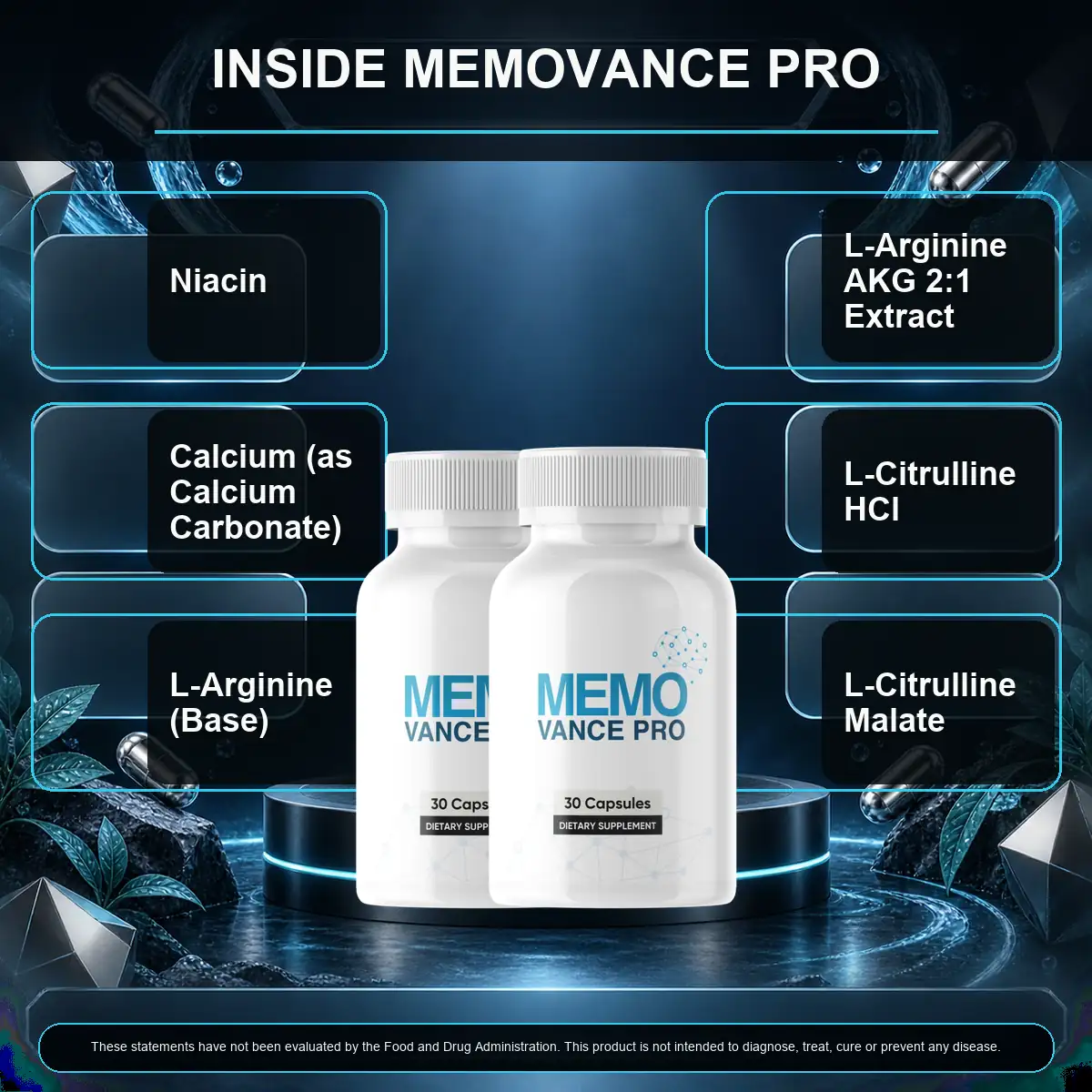
Two of the seven rows on this bottle are citrulline and two are arginine, which looks like padding until you know what happens to swallowed arginine in the first twenty minutes. It is the one genuinely clever decision on this panel, and the amounts are where it comes apart.
- Arginine is the raw material the vessel wall turns into nitric oxide, the signal that relaxes a small artery.
- Swallowed arginine meets an enzyme called arginase in the gut wall and the liver, and a large share never reaches circulation intact.
- Citrulline avoids that step entirely and is converted to arginine in the kidney, so gram for gram it raises plasma arginine further.
- That is why a serious formula carries both, and it is a real piece of pharmacology rather than a marketing pairing.
- The human work in this area runs at grams a day. The four amino acid rows here come to 600 mg in total.
The enzyme that eats swallowed arginine
Arginine is what biochemists call a conditionally essential amino acid: the body makes it, and under ordinary conditions it makes enough. It also arrives in quantity from food. Meat, fish, nuts, seeds and pulses supply somewhere around four to five grams across a normal day, which is worth holding in mind before any capsule is considered.
Its claim on a cognition label comes from one reaction. An enzyme in the lining of every blood vessel, nitric oxide synthase, converts arginine into nitric oxide. Nitric oxide is the signal that tells the smooth muscle around a small artery to relax, which widens the vessel and increases flow through it.
The trouble begins before any of that. Arginine is also the substrate for a completely different enzyme, arginase, which breaks it down into ornithine and urea. Arginase sits in the intestinal wall and in the liver, which means a swallowed dose meets it twice on the way in.
How much survives
Enough of the dose is lost at those two checkpoints that the relationship between what is swallowed and what reaches the bloodstream is poor. A review of supplemental arginine catabolism sets out what the body does with it, and the picture explains a great deal about why the human literature starts at quantities that look absurd on a capsule label.
What that does to a dose
The practical consequence shows up in the outcome trials. A dose-response meta-analysis of arginine and blood pressure pooled the randomised evidence and found the effect appearing at four grams a day and above. Below that, nothing measurable. Above nine grams, also nothing, and nothing in trials running past about three and a half weeks.
Four grams a day is a lot of capsule. At 200 mg a row it is twenty of them, taken daily. That is not a criticism of any particular product; it is the scale the literature works at, and any label carrying arginine is competing against it whether it mentions the figure or not.
The same problem shows up in the alpha-ketoglutarate version. The pharmacokinetic and performance study of arginine AKG gave four grams three times a day, twelve grams in total, to trained adult men. The salt was formulated on the theory that the keto-acid half improves what survives the gut, and the researchers still worked in grams.
Where citrulline enters the story
Citrulline is the elegant answer to arginase, and it is not a marketing invention. It is a genuine intermediate in the urea cycle, which is the pathway the body already uses to move nitrogen around.
The important property is negative: citrulline is not a substrate for arginase. Swallowed, it passes the intestinal wall and the liver essentially untouched and is taken up by the kidney, where an enzyme pair converts it to arginine. The conversion happens downstream of both checkpoints.
So a given weight of citrulline raises circulating arginine further than the same weight of arginine does. That is the whole argument for the ingredient, it is well established, and it is why any formula built on this pathway that carries only arginine is a less well-designed formula than one that carries both.
| Swallowed arginine | Swallowed citrulline | |
|---|---|---|
| First obstacle | Arginase in the intestinal wall, then again in the liver | None of consequence. It is not a substrate for arginase |
| What the body does with it | A large share is broken down to ornithine and urea before general circulation | Passes through and is taken up by the kidney |
| Where it becomes useful | Whatever survives reaches the bloodstream as arginine | Converted to arginine in the proximal tubule, downstream of the obstacle |
| Effect on plasma arginine | Rises, but inefficiently for the amount swallowed | Rises further, gram for gram |
| Quantities used in human studies | Four grams a day and upwards in the blood pressure literature | Two grams at the lowest arm of the dose-ranging study |
Drawn from the catabolism review and the pharmacokinetic study cited below. Both columns describe the molecules, not this or any other capsule.
The two routes, side by side
Reading that table from top to bottom, the citrulline column is better at every step except the last. The quantities are the problem in both columns and they are the reason this article exists.
It is also worth noticing what the table does not say. Neither column claims that raising plasma arginine changes anything a person would notice. That is a separate question and it comes two sections further down.
What the dose-ranging study measured
The Citrudose pharmacokinetic study is the reference point for anybody reasoning about a citrulline row. Healthy volunteers took citrulline at 2, 5, 10 and 15 grams in random order, and plasma amino acids and hormonal patterns were followed afterwards.
Four things about that design are worth extracting. The researchers chose grams rather than milligrams as their unit. Their smallest arm was two grams. They escalated by a factor of seven and a half across the study. And they measured plasma levels rather than an outcome anybody would feel, because plasma levels are what a dose-ranging study is for.
That last point matters when a marketing page cites the study. It established what citrulline does to blood chemistry at gram scale. It did not establish that anything improved for anybody.
See every MemoVance Pro amount beside the one its research used
Seven rows, seven printed figures, and the quantity each trial worked at set next to it. Three packs from $49 a bottle, one capsule a day, and 180 days from the date of purchase to change your mind.
$79, $69 or $49 a bottle by pack size · 180-day money-back guarantee
Order MemoVance Pro On The Official WebsiteLot MEM-26/TH-4477 · 30 capsules · 7 rows, 7 printed figures
What happens once plasma arginine rises
Raising a substrate is not the same as producing an effect, and the friendliest experiment in this whole area is a useful benchmark for how much it takes.
A contrast-enhanced ultrasound crossover in healthy young athletes measured muscle perfusion directly after a supplement serving, which is about as close to the mechanism as a human study gets. It found a response.
The serving contained three grams of arginine hydrochloride, eight grams of citrulline malate and 300 mg of green tea extract. Eleven grams of amino acids, in one dose, to move blood flow in a leg measurably enough to publish.
Anybody reasoning about a cognition capsule should hold that number rather than the mechanism diagram. The mechanism is real; the entry fee is high.
The pooled outcome data is flat
The least flattering result in this area is also the one most worth knowing, and it concerns citrulline specifically.
A meta-analysis in Current Hypertension Reports pooled the clinical trials of citrulline supplementation and blood pressure and reported no significant effect. The brachial systolic change was a fraction of a millimetre of mercury with a confidence interval crossing zero, and the central pressure result was similar.
That is at trial doses. A mechanism that is real, at quantities far above any capsule, producing a pooled outcome of nothing, is a fact that has to sit beside the pharmacology rather than after it.
What that means for a 100 mg row
Putting the printed figures next to the research quantities makes the arithmetic unavoidable, which is the whole advantage of a panel that prints them.
| Row on this panel | Printed amount | The quantity its own research used |
|---|---|---|
| L-Arginine (base) | 200 mg | 4 g a day was the threshold in the pooled trials |
| L-Arginine AKG 2:1 | 200 mg | 12 g a day in the pharmacokinetic study |
| L-Citrulline HCL | 100 mg | 2 g in the smallest arm of the dose-ranging study |
| L-Citrulline Malate | 100 mg | 8 to 12 g in the performance trials |
| All four together | 600 mg | The friendliest perfusion result used 11 g in one serving |
Printed amounts are read off the label artwork. Research quantities are from the records cited at the foot of this article.
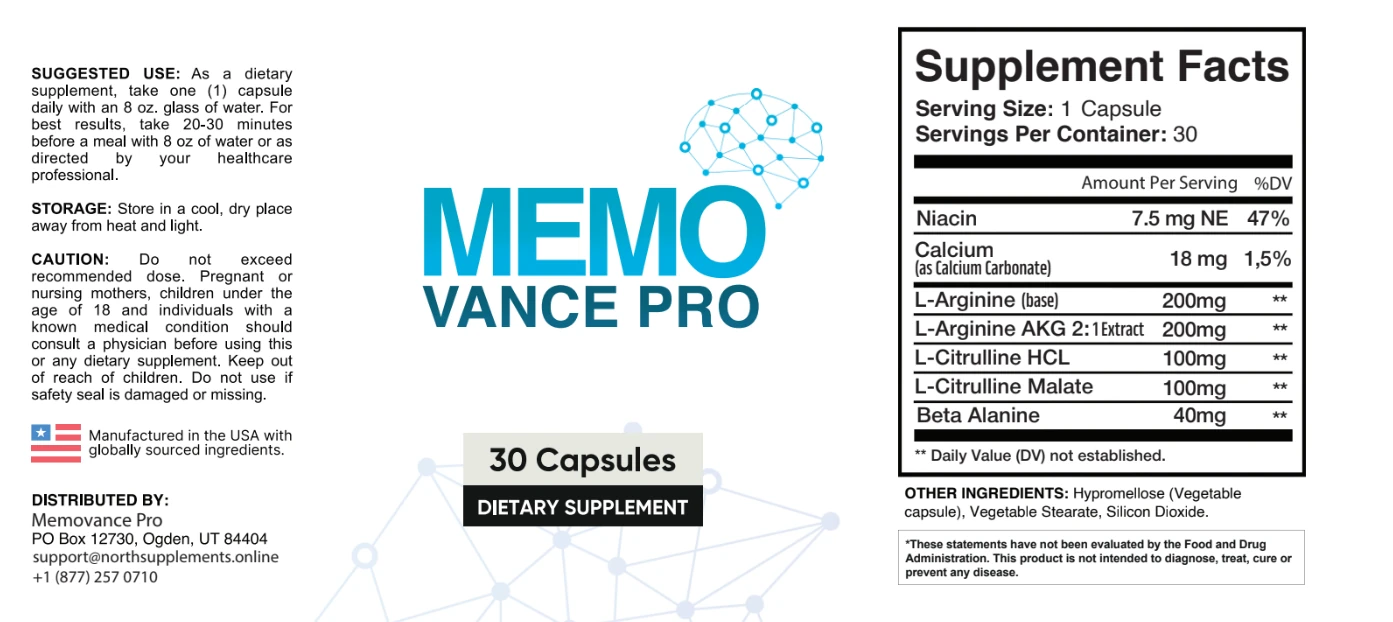
Four rows, 600 mg between them, against a literature whose smallest serious arm was two grams of one ingredient. The direction is consistent, which makes it one finding rather than four, and it points at a single design decision: cover the pathway from both ends rather than push any part of it.
The full row-by-row comparison, including the two nutrient rows, is in the dosage analysis, and every printed figure is on the panel page.
Why a formula carries both anyway
Given all of that, is the citrulline pairing worth anything on a label like this one? Two honest answers, and they point in different directions.
In favour: it shows somebody specified the formula knowing the pharmacology. A capsule carrying 400 mg of arginine and no citrulline would be a worse-designed capsule, and whoever chose these seven rows understood the first-pass problem well enough to spend a third of the amino acid budget on the solution.
Against: solving the delivery problem for a quantity that is twenty times below the threshold does not produce a result. Efficient delivery of too little is still too little, and no amount of good pharmacology upstream changes that.
Both are true. Which one matters more depends on whether you are assessing the thinking behind a formula or the effect of taking it.
Three questions for any arginine label
- Is there a citrulline row at all? A formula built on the nitric oxide pathway that carries only arginine has skipped the part of the pharmacology that matters most.
- What do the rows come to in grams? Add them up and compare with four grams, which is where the pooled blood pressure evidence begins. Most capsules will be one or two per cent of it.
- Does the label print a figure for each row, or one total? A blend total makes both of the questions above unanswerable, which is the real reason a blend is a problem.
Those three take about thirty seconds on any bottle in this aisle, and they are the same checks the scorecard applies to this product, which fails one of them outright.
Everything above describes what arginine and citrulline do in a laboratory and in published trials, at quantities measured in grams. None of it is a claim that this capsule changes blood flow, thinking or anything else in any individual, and none of it is medical advice. Anyone taking a medicine for blood pressure, angina or erectile function is taking something that acts on the same route, and that is worth one sentence at the next appointment.
References
- Wu Z, Hou Y, Hu S, et al. Catabolism and safety of supplemental L-arginine in animals. Amino Acids. 2016;48(7):1541-52. PMID 27156062. https://pubmed.ncbi.nlm.nih.gov/27156062/
- Shiraseb F, Asbaghi O, Bagheri R, et al. Effect of l-Arginine Supplementation on Blood Pressure in Adults: A Systematic Review and Dose-Response Meta-analysis of Randomized Clinical Trials. Adv Nutr. 2022;13(4):1226-1242. PMID 34967840. https://pubmed.ncbi.nlm.nih.gov/34967840/
- Moinard C, Nicolis I, Neveux N, et al. Dose-ranging effects of citrulline administration on plasma amino acids and hormonal patterns in healthy subjects: the Citrudose pharmacokinetic study. Br J Nutr. 2008;99(4):855-62. PMID 17953788. https://pubmed.ncbi.nlm.nih.gov/17953788/
- Mirenayat MS, Moradi S, Mohammadi H, Rouhani MH. Effect of L-Citrulline Supplementation on Blood Pressure: a Systematic Review and Meta-Analysis of Clinical Trials. Curr Hypertens Rep. 2018;20(11):98. PMID 30284051. https://pubmed.ncbi.nlm.nih.gov/30284051/
- Buerkle F, Kaeppeler J, Kropp M, et al. New perspectives for investigating muscular perfusion response after dietary supplement intake: an exploratory, randomized, double-blind, placebo-controlled crossover trial in healthy young athletes using contrast-enhanced ultrasound (CEUS). J Int Soc Sports Nutr. 2022;19(1):397-416. PMID 35859621. https://pubmed.ncbi.nlm.nih.gov/35859621/
- Campbell B, Roberts M, Kerksick C, et al. Pharmacokinetics, safety, and effects on exercise performance of L-arginine alpha-ketoglutarate in trained adult men. Nutrition. 2006;22(9):872-81. PMID 16928472. https://pubmed.ncbi.nlm.nih.gov/16928472/