MemoVance Pro Official Website › Blog › What A Registered Facility Mark Means
What A Registered Facility Mark On A Supplement Means
Four marks travel with this pack. Two of them name no organisation at all, which means no reader can follow either one up. That is not an accusation of anything; it is a description of what a mark makes possible, and it is the only question a quality page can actually answer.
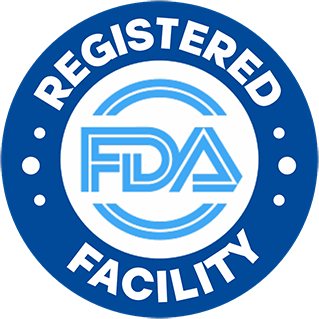
- Facility registration is a list that manufacturers are legally required to join. It is not approval, inspection or endorsement.
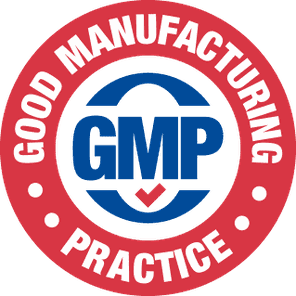
- Current good manufacturing practice is a legal requirement for every supplement manufacturer in the United States, so a GMP mark announces compliance with a mandatory standard.
- Neither mark on this pack names an organisation, and the label names a distributor rather than a manufacturer.
- One of the four marks is corroborated by the printed label, which is worth saying as plainly as the criticism.
- The panel on the back of the bottle is worth more than all four marks, because a reader can check it alone.
What a mark on a pack is for
A compliance mark exists to transfer trust. The reader cannot inspect a factory, so a symbol stands in for somebody who can, and the value of the symbol depends entirely on whether that somebody can be identified.
Which makes the test simple and uncomfortable. A mark that names the organisation behind it can be followed up in a browser. A mark that names nobody asks the reader to accept the transfer on faith, which is the opposite of what a mark is supposed to do.
This is not a subtle distinction and it is not a matter of opinion. It is the difference between a credential and a graphic.
Registration is a list, not a licence
Anybody making, handling or storing food for the American market has to tell the agency where they do it. That notification is the registration: it creates a database entry, it is renewed on a schedule, and there is nothing voluntary about it.
Being on a list is a thin thing to put on a box. Nobody examined a product to create the entry, nobody read a formula, and nobody opened a capsule. The agency says in its own consumer material that supplements are not approved before they go on sale, which is the sentence the roundel is most often taken to contradict.
Both statements sit on the same website, incidentally. Every page in this category carries a footer saying the product is not approved and its claims have not been evaluated, and the pack carries a roundel implying an agency relationship. Neither is false. They are simply answering different questions.
The narrower problem on this pack
A registration attaches to premises. This artwork identifies a distributor, a postal box, a telephone number, an email and a country of manufacture, and it stops there.
So the entry the roundel points at cannot be located by anybody holding the bottle, because nothing on the bottle says which premises to look for. That is a different criticism from saying the claim is untrue, and it is the one a reader is in a position to make.
GMP is a legal floor
Manufacturing practice for supplements is written into federal regulation, and it is mandatory rather than aspirational. Staff, premises, equipment, incoming material checks, batch records and what happens when somebody complains are all covered by it.
A badge announcing that a legal requirement is being met is announcing that the law is being followed. That is worth knowing and it is roughly the status of a kitchen that passed its inspection, rather than one that won a prize.
There is a version of this badge that means considerably more. Trade bodies and testing laboratories audit supplement plants against published schemes and issue numbered certificates, and their badges print the auditor's name, because a number with no issuer attached to it is worth nothing.
The badge here prints no issuer, which lands it in the same place as the roundel above: a statement with no handle on it.
The two questions to ask of any mark
- Who is named on it? An agency, an auditor, a standards body, a laboratory. If the answer is nobody, the mark is a design element.
- Can it be looked up? A certificate number, a licence reference, a searchable register. If there is nothing to type into a search box, the answer to question one did not help.
Ten seconds, any aisle, any pack. They are the same two questions behind check five of the six-point scorecard published here, and this product does not survive either of them.
Order MemoVance Pro knowing what each mark is worth
Two marks name nobody, one agrees with the printed label, and the panel behind them prints seven figures anybody can check. 180 days from the date of purchase to decide.
$79, $69 or $49 a bottle by pack size · 180-day money-back guarantee
Order MemoVance Pro On The Official WebsiteLot MEM-26/TH-4477 · 30 capsules · 7 rows, 7 printed figures
The four marks, audited
| Mark | What it asserts | Who is named on it | Can a reader follow it up? |
|---|---|---|---|
| Registered facility roundel | That the facility is registered with the agency | Nobody. No manufacturer appears on the artwork | No |
| Good manufacturing practice | That production follows current GMP | No certifying body | No |
| Foreign and domestic ingredients | That materials come from US and overseas sources | Nobody, but the printed label says the same thing | Partly, against the label |
| Money-back satisfaction | That an unsatisfied buyer can have a refund | The seller, implicitly. No term is printed on the mark | Only via the package cards |
Read from the seal artwork shipped with this product and checked against the label in the same set.
Two fails, one partial pass and one commercial statement. The fourth row deserves a sentence of its own: a money-back mark is a real policy accurately represented, and it prints no number of days, which leaves the useful part off. The term comes from the seller's package cards instead.
The one mark with something behind it
The foreign-and-domestic-ingredients seal says raw materials come from both United States and overseas sources. The printed label carries the line “Manufactured in the USA with globally sourced ingredients”.
Those are the same statement appearing independently in two places, which is the only kind of corroboration available to somebody holding a bottle. It is worth crediting as clearly as the other two are worth criticising.
It is also a claim worth understanding rather than treating as evasive. Nearly every amino acid on the market is produced by bacterial fermentation at a small number of plants worldwide. A formula of this kind carrying globally sourced material is ordinary; a formula claiming every ingredient was grown domestically would be the surprising one.
Two more things that can be checked
The capsule shell is named on the other-ingredients line as hypromellose, a cellulose polymer used across oral dosage forms, which is what makes the capsule suitable for a vegetarian diet. The anti-caking agent beside it, silicon dioxide, has been through a full additive re-evaluation in Europe. Neither is a quality mark, and both can be looked up in a minute.
What a checkable mark looks like
| A mark that can be checked carries | Why it matters |
|---|---|
| The name of the certifying body | It is the organisation that did the work, and it can be contacted |
| A certificate or licence number | It is what turns a claim into a lookup |
| The standard audited against | Different standards test different things |
| A date or an expiry | A certification is a snapshot, not a permanent state |
| The name of the facility covered | A certification covers a site, not a brand |
Five fields. A mark carrying none of them is a graphic rather than a credential.
None of those five fields is exotic and marks carrying all five exist throughout this industry. A pack that carries them has given a reader something to do; a pack that carries none has given them a picture.
What a buyer can verify with no marks at all
This is where the argument turns, and it is the reason this article is on a website that sells the product.
The panel prints 7 rows with 7 figures and no blend total. Every amount can be compared with the amount its own published research used, from an armchair, with no cooperation from anybody. The inactive line names three ingredients and stops. The origin statement is printed. The distributor can be reached by post, telephone and email.
That is a substantial amount of verifiable material, and it is worth more than four marks that cannot be followed up, because it does not depend on trusting anybody.
Six checks against the artwork, taking about five minutes, are set out on the batch verification page, and the quality page works through each mark at greater length.
Three things worth asking a seller
- Which facility fills the bottles? One line of artwork, and it turns a registration mark from a category claim into a checkable one.
- Which body issued the manufacturing-practice mark, and what is the reference? If the answer is that no body issued it, that is also an answer.
- Is there a lot-specific certificate of analysis? It is the only document that speaks about the contents rather than about the process.
None of those is an unreasonable question and all three are asked regularly in this industry. A seller who answers them has raised the floor for everybody, and the worst outcome of asking is learning something. The NIH Office of Dietary Supplements publishes a plain-language page on what to ask about a supplement generally.
A compliance mark says something about a factory, not about a formula and certainly not about a person. Nothing on this page is medical advice, and a dietary supplement is not approved as a treatment for anything. Where a symptom is the reason somebody is shopping in this aisle at all, the useful step is an appointment rather than a better seal on a box.
References
- Questions and Answers on Dietary Supplements. U.S. Food and Drug Administration. https://www.fda.gov/food/information-consumers-using-dietary-supplements/questions-and-answers-dietary-supplements
- Dietary Supplements: What You Need to Know. Office of Dietary Supplements, National Institutes of Health. https://ods.od.nih.gov/factsheets/WYNTK-Consumer/
- Using Dietary Supplements Wisely. National Center for Complementary and Integrative Health, National Institutes of Health. https://www.nccih.nih.gov/health/using-dietary-supplements-wisely
- Guarve K, Kriplani P. HPMC- A Marvel Polymer for Pharmaceutical Industry-Patent Review. Recent Adv Drug Deliv Formul. 2021;15(1):46-58. PMID 34086557. https://pubmed.ncbi.nlm.nih.gov/34086557/
- EFSA Panel on Food Additives and Nutrient Sources added to Food (ANS). Re-evaluation of silicon dioxide (E 551) as a food additive. EFSA J. 2018;16(1):e05088. PMID 32625658. https://pubmed.ncbi.nlm.nih.gov/32625658/